
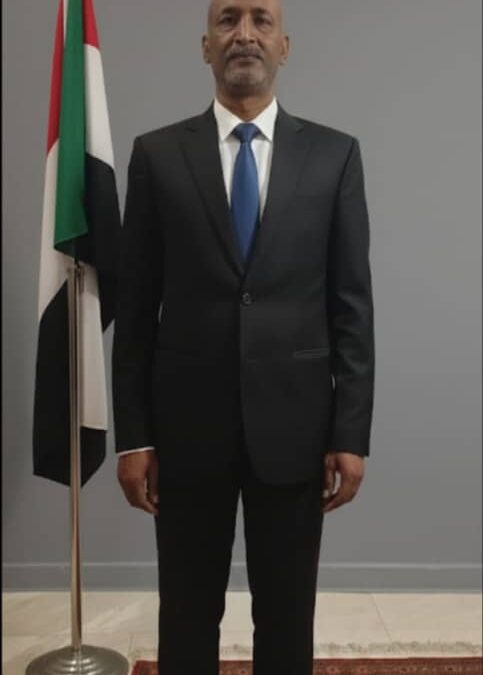
Let me put it plainly: what do we expect from one another in Sudan?
By: Mohammed Sharia
Let us set the record straight on a principle that has caused confusion for many in the Sudanese context:
Not everyone who agrees with Al-Kizan is a member of the group, not everyone who agrees with Sumud is a member of that organisation, not everyone who criticises the army is an enemy of the nation, and not everyone who supports the army is necessarily a government loyalist.
Politics is not a test of loyalty, and the nation is not just two camps.
I may agree with someone with whom I disagree on a hundred issues, yet disagree with him on a single issue on which I agree with someone else; this does not make me a member of his group, nor a supporter of his cause.
An idea is discussed for its own sake, not in the name of its author.
If someone expresses an opinion that partly agrees with the Kizan, do not label them a ‘Kuz’ simply because of the similarity.
And if he expresses an opinion that is in line with «Sumud», do not attribute it to Sumud.
And if he criticises the government or the army, do not label him a traitor or an agent.
And if you criticise the Rapid Support Forces, do not automatically label them as patriots.
Patriotism does not mean applauding, just as opposition does not mean hurling abuse.
The problem is that we’ve turned politics into membership cards
Either you’re with us – in which case you’re a patriot – or you disagree with us – in which case you’re a traitor.
Either you applaud the army, in which case you are a patriot, or you criticise its performance, in which case you are against the army and the nation.
Either you reject the Kezans in every respect, or you’re a Koz.
Either you agree with «Samoud» on everything, or you are in the camp of its opponents.
This is a dangerous mindset for Sudan.
Because it destroys the most important thing we need right now: an independent mind.
I do not want to be a carbon copy of the government, nor of the opposition, nor of Al-Kizan, nor of Sumud, nor of any political movement.
I want to be a Sudanese with a mind of my own, my own views and my own stance.
I support what I believe to be right, reject what I believe to be wrong, and reconsider my position if the truth becomes clear to me.
The army is not the government… and the state is not a person
Citizens have the right to respect the army as a national institution, whilst at the same time questioning its mistakes.
He has every right to reject the Rapid Support Forces and their crimes, whilst at the same time rejecting the politicisation of the armed forces.
He has the right to criticise the government without being an enemy of the state.
The army is one thing, the government is another, and the state is something else entirely.
The state endures, whilst governments and people come and go.
A strong state is not one in which citizens are afraid to criticise the authorities, but one in which its institutions are able to listen to criticism and correct their mistakes.
Political parties are not the nation
Just as we must not reduce the state to the government, we must not reduce Sudan to a single party, movement or political group.
No, the Kizans do not own Sudan.
Nor does Sudan have the resilience to hold out.
Nor does the army control Sudan.
Nor does Sudan have Rapid Support Forces.
No single party, movement or group claiming to represent the people has the sole right to determine Sudan’s future.
Sudan belongs to all its people, and true legitimacy is granted by the people.
I therefore reject political betrayal in all its forms.
You must not say to a citizen: ‘You’re a coward because you agreed with the cowards in that situation.’.
And don’t say to him: ‘You’re being stubborn because you agreed with her on another occasion.’.
Discuss his opinion… Don’t look for his membership card.
We need media and policies that raise awareness, not take sides
The most dangerous thing that could happen to Sudan is for the media to become tools for mobilising factions rather than raising awareness.
We want a media that asks:
Who was at fault?
Why did I make a mistake?
What is the alternative?
Who is held to account?
How do we build a state?
How can we end the war?
How can we prevent this from happening again?
How do we build a professional national army?
How do we transition to a democratic, secular state?
No media outlet is content merely to ask:
Whose side are you on?
This question alone will not build a nation.
I don’t want to be “with” anyone… as much as I want to be with Sudan
I may have disagreed with the Keizans on one point, but agreed with them on another.
I disagreed with Samoud on one point, but agreed with her on another.
I may support one of the government’s positions and reject another.
I have commended one action by the army whilst criticising another.
And this is not a contradiction… this is independence.
The real contradiction lies in making your views dependent on individuals and groups, so that you applaud what is right simply because it comes from your own group, and reject what is right simply because it comes from your opponent.
Sudan does not need citizens who simply applaud.
Sudan needs citizens who think for themselves.
Nor does it need citizens who repeat:
Who are you with?
Rather, it needs someone to ask:
What is the right path for Sudan?
A Vision for a New Sudan
We need to move on:
From accusations of treachery to dialogue.
From alignment to independence.
From individuals to organisations.
From slogans to programmes.
From reverence for authority to scrutiny of it.
From monopolising the truth to respecting differences.
From conflict between factions to nation-building.
We do not want military rule, nor militias, nor a party monopoly, nor tutelage from any quarter, nor exclusion in the name of the revolution, nor legitimacy conferred by force of arms.
We want a country where:
The army is for the country, not for politics.
The party is for elections, not for weapons.
The government is there to serve the people, not to rule over them.
The media should serve to raise awareness, not to mobilise.
And difference, truly, is no offence.
And elections are the path to power.
And let me make this clear:
We will not build Sudan if every Sudanese is still required to choose a side before being allowed to have an opinion.
My name is Muhammad Sharia; I do not ask anyone to agree with me.
I simply ask that he engage with what I say, rather than judge me on the basis of those who agree with part of my view.
We may disagree on the path, but our goal must be the same:
Sudan first… then everyone else.
Mohammed Sharia
 Arabic
  English (UK)
  Français
  Deutsch
  日本語
日本語  Español
  简体中文
简体中文